

In today’s business environment, where speed and reliability in financial decision-making are vital, AI is becoming a strategic ally for finance departments. And SAP understands this well!
Integrated into SAP S/4HANA and SAP Analytics Cloud (SAC), SAP AI automates time-consuming tasks, makes processes more reliable and transforms data into a powerful financial management tool.
From accounting closures to cash flow forecasting, anomaly and fraud detection, SAP AI offers finance teams a unique opportunity: to move from an operational role to one of analysis and strategic advice.
How? Sileron has summarised the key points for you.

First of all, what is SAP AI?
- automate repetitive tasks (invoicing, reconciliations, accounting entries),
- detect anomalies and secure transactions,
- provide intelligent recommendations based on data,
- generate financial, logistical or HR forecasts
- adapt to regulatory changes.
Your SAP publisher therefore offers you not just “generic” AI, but business AI. This is designed to directly meet the needs of your finance, supply chain, HR, purchasing and logistics functions.
What are the different forms of SAP AI for finance?
At a time when AI is being talked about indiscriminately, it is important to redefine AI in its various forms.
It is clear that SAP’s objective here is not to provide generic AI, but rather contextualised AI. In other words, AI that is integrated into financial, logistics and HR processes to accelerate the digital transformation of the company’s services.
This includes:
1. Embedded AI
Included in SAP S/4HANA and SAP S/4HANA Cloud ERP systems, it enables the following for finance departments:
- automatic bank reconciliations,
- intelligent invoice processing,
- intelligent suggestions in workflows (e.g. invoice approval).
It is ready to use and designed for immediate productivity.
2. Machine learning
SAP has long integrated machine learning models to:
- learning from historical data,
- continuously improve the accuracy of financial forecasts (cash flow, DSO, cash flow),
- detect accounting anomalies or fraud patterns.
These models can be pre-trained and standard (provided by SAP) or customised via SAP BTP (Business Technology Platform).
3. Process Automation (SAP Build Process Automation)
Formerly grouped under SAP Intelligent RPA and SAP Workflow, SAP Build Process Automation is the SAP BTP building block that enables you to automate and orchestrate business processes, particularly financial processes in and around your SAP ERP.
It is a low-code/no-code solution that will enable you to:
- combine RPA (Robotic Process Automation) and AI,
- end-to-end automation of your financial workflows: order validation, creation of accounting entries, reconciliations, etc.
- add “intelligent decision-making” through AI, where RPA is limited to mechanical execution.
For example, SAP has recorded a 71% reduction in the effort required to reconcile customer accounts. Thanks to its AI, 90% of payments are automatically matched to bank statements.
Note: SAP Build Process Automation integrates natively with S/4HANA Finance ERP.
4. Natural Language Processing (NLP)
You have probably heard about Joule, SAP’s new conversational co-pilot based on generative AI and NLP.
But did you know that before Joule, SAP was already using natural language processing (NLP) in its solutions? This was particularly the case in SAC and chatbots. However, the applications were limited and the uses more restricted.
Today, SAP Finance users can:
- interact with SAP ERP using natural language: financial chatbots, virtual assistants,
- perform intelligent searches for documents or transactions.
For example, an accountant can ask SAP to “show me all invoices awaiting approval this month“. And the time savings are clear! In S/4HANA Cloud Private Edition, information searches are 95%* faster than before. Your accountant can therefore expect to find the invoices they are looking for in just 30 seconds*, compared to an average of 10 minutes* previously.
*Source: SAP
5. Predictive and analytical AI
Traditionally, finance teams worked on the basis of historical data. Now, with SAP AI, you can rely on analytics to understand what happened and why. But you can also use predictive analytics to anticipate what might happen.
This means you can rely on:
- integrated sales forecasts and cash flow,
- financial scenario simulations,
- early detection of late payments or liquidity risks
- the ability to transform and present your financial data into powerful strategic analyses.
With AI, SAP S/4HANA combines the best of analytics and predictive technology to help finance managers and CFOs make quick, informed decisions. SAP estimates a 50% time saving on financial reporting. In this way, it transforms the finance function into a true strategic partner for the business.
Saving time, improving accuracy and reducing costs: the key challenge of automatable financial processes
As we have seen, AI in SAP S/4HANA (and its extensions via SAP BTP) enables the automation of a large number of financial processes, particularly those that are repetitive and time-consuming, based on structured data and subject to rules (accounting, tax or regulatory).
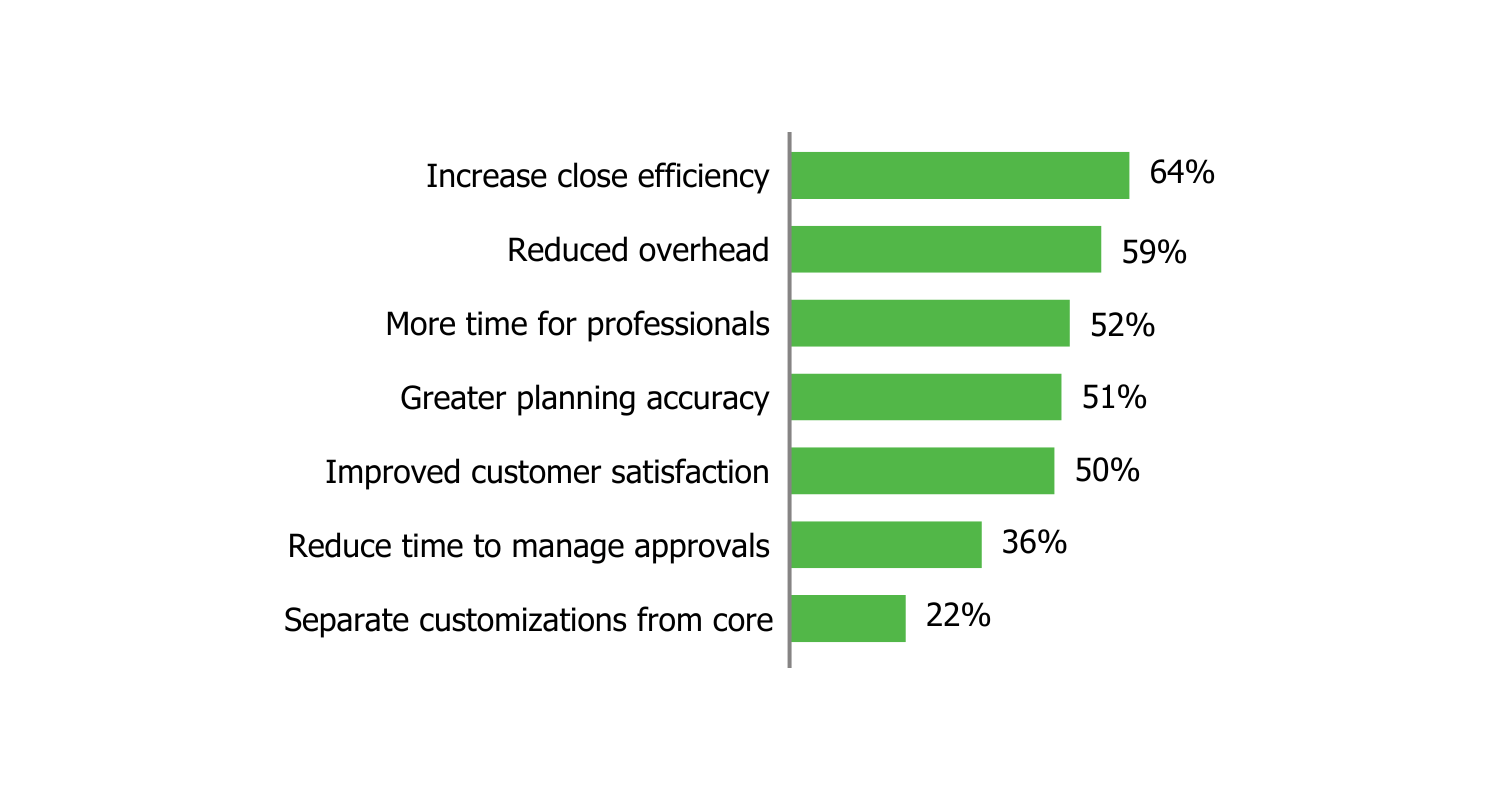
In its report “AI and automation in Finance 2024”, SAP highlighted the main benefits expected by financial leaders when integrating automation and AI into their processes:
Comparative table – Examples of finance process automation with SAP AI
This non-exhaustive table lists the automations you can consider in S/4HANA to improve the performance of your finance department:
| Finance process | Automation using SAP AI | Key benefits |
|---|---|---|
| Financial closing |
|
|
| Accounts payable |
|
|
| Accounts receivable |
|
|
| Cash flow forecasts |
|
|
| Budget planning |
|
|
| Compliance and fraud detection |
|
|
Fraud detection: a major advance for finance departments thanks to AI
According to the ACFE (Association of Certified Fraud Examiners), companies lose an average of 5% of their annual revenue due to fraud. This can amount to tens or even hundreds of millions of pounds per year.
AI-based anomaly and fraud detection relies on a combination of machine learning, advanced statistics and, in some cases, business rules. In an environment such as SAP S/4HANA Finance or SAP Analytics Cloud (SAC), this translates into integrated algorithms capable of identifying unusual behaviour in massive financial flows.
This is based on:
The integration of Artificial Intelligence into SAP heralds a new era for finance departments. As we have seen, there are many concrete use cases. Beyond saving time and reducing errors, AI enables the finance function to become a strategic player in the company, capable of anticipating and driving performance.
Leveraging SAP AI through your S/4HANA ERP or SAP Analytics Cloud is much more than just a technology project: it is a driver of competitiveness and innovation.
To find out more, contact our dedicated ERP Finance team.